2026/03/02 11:41 WORLD
Pulsing Rivers, Fish Schools— SUSTech Empowers China-Ethiopia Smart Water Management
By the waters of Taihu Lake in Suzhou, a group of students from Suzhou University of Science and Technology (SUSTech) are injecting technological power into aquatic ecological protection through their independently developed "Intelligent Acoustic-Visual Monitoring and Ecological Health Evaluation System for Aquatic Fish". The system not only achieves all-weather, high-definition monitoring of underwater fish activities but also automatically generates "physical examination reports" on aquatic ecological health, marking the transformation of aquatic ecological monitoring from "manual sampling" to "intelligent perception". This Chinese technological strength is now marching into Africa along the Belt and Road, shining brightly in Ethiopia, providing a practical model for the transformation of smart urban water management locally, and fostering profound friendship between China and Ethiopia through joint efforts in talent cultivation and ecological protection.
From Laboratory to Taihu Lake: Interdisciplinary Innovation Solves Smart Water Management Monitoring Dilemmas.For a long time, fish monitoring has mainly relied on manual sampling, which is plagued by problems such as high work intensity, insufficient spatiotemporal continuity, and fragmented data—failings that cannot meet the requirements of "precision, real-time performance, and full-chain management" for water governance in smart cities. Under the overall guidance of the School of Environmental Science and Engineering of SUSTech and the supporting guarantee of Suzhou Environmental Monitoring Station, a teacher-student team led by young teachers Ma Yixuan, Yu Qi, and Zhu Liqi, integrating interdisciplinary backgrounds in environmental science, optical engineering, and electronic information, has innovatively integrated underwater camera and sonar technology to develop the "acoustic-visual synergy" intelligent monitoring system. The system can synchronously acquire fish images and 3D contour information, realizing in-situ, non-intrusive continuous observation. The core data collected can seamlessly connect to urban smart water management platforms such as "Smart Water Suzhou", providing stable and reliable data support for refined management including aquatic ecological health assessment, flood control scheduling, and optimal allocation of water resources. It perfectly aligns with Suzhou's development plan of promoting digital reform of water management and building a modern water network system. As a concentrated manifestation of the university's advantages in environmental disciplines, this technological innovation not only addresses the pain points of traditional water monitoring but also constructs a closed-loop water governance of "perception-analysis-decision-making" in smart cities, laying the foundation for subsequent international cooperation.
Beyond Monitoring: Data-Driven Precision in Smart Ecological Assessment."The value of this system lies not only in 'being able to see' but also in 'being able to evaluate accurately'—it can further provide decision-making basis for smart water management," introduced Zhang Zixuan, a key participant in the project, at the effectiveness evaluation site of the "Ecological Island" construction in Jinting Town, Wuzhong District. The implementation of the system not only accurately supports the real-time monitoring of the ecological island's construction effectiveness but also breaks the "information silos" in water governance through data interconnection, realizing the transformation of governance philosophy from "passive response" to "proactive early warning". Currently, the system has been operating stably in the Taihu Lake Germplasm Resources Protection Area, continuously monitoring various aquatic organisms such as Taihu whitefish and mandarin fish. The quantitative data generated can directly serve the evaluation of fishing ban effectiveness and the tracking of ecological restoration, and further provide scientific support for core scenarios of smart water management such as urban flood control and drainage, and water resource scheduling. Its mature technical system and application model have laid a solid foundation for "going global" to participate in the construction of smart cities in Belt and Road countries.
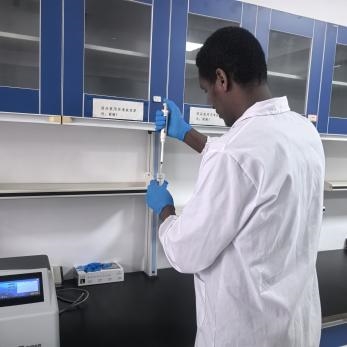
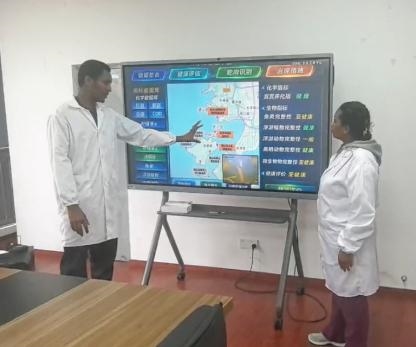
Fruits of the Belt and Road: China-Ethiopia Jointly Cultivate Ecological Guardians.Relying on the core technology, the students have established an environmental protection technology company to promote the transformation of achievements. The project has obtained multiple patent authorizations, published more than 10 academic papers, and reached cooperation intentions with relevant government departments. Its technology has been integrated into the local smart water management "unified management through one network" system. The pilot project in Ethiopia is not only a symbol of the technology's entry into the Belt and Road but also a model of Sino-Ethiopian collaborative innovation in the field of smart urban water management. For many years, SUSTech has been cultivating talents in environmental protection for developing countries. During their studies at SUSTech, international master's students from Ethiopia joined the teacher-student team, participating in the entire process of system research and development and Taihu Lake pilot practice, and gaining in-depth understanding of the core concept of China's smart water management of "data-driven, collaborative governance". Teachers and students from China systematically taught them core technologies including underwater monitoring equipment operation, data analysis, and model optimization, and further shared experience on how to connect monitoring data with urban water management platforms to achieve integrated intelligent management and control of water resources, aquatic ecology, and water environment. Today, after bringing the technology back to Ethiopia, these students have successfully integrated the system with the local water management system, realizing real-time monitoring and intelligent analysis of the waters of Lake Hawassa, and promoting the transformation of local water management towards digitalization and sustainability. It has injected key momentum into the construction of smart cities in Ethiopia, and this practice echoes Ethiopia's efforts to promote ecological restoration strategies, adding a vivid footnote to China-Africa cooperation in green development.
Educating for Reciprocity: Interdisciplinary Talent Cultivation Empowers International Smart Water Cooperation.This project is not only a technological innovation but also a dual practice of interdisciplinary education and international cooperative education. Among the team members, 4 have won National Scholarships, 13 have continued to pursue master's degrees, and 6 are studying for master's or doctoral degrees. Through the "teacher-led, student-innovated" model, Chinese students have improved their scientific research and entrepreneurial capabilities in practical battles, and further broadened their international horizons through collaboration with international students, becoming bridges and links for ecological cooperation under the Belt and Road Initiative. This two-way empowering education model not only feeds back the university's innovation and entrepreneurship education and foreign aid training work but also cultivates a group of professional talents in smart water management with both technical capabilities and international perspectives, serving as a vivid case of industry-education integration and international cooperation.
In the future, the team plans to further optimize the system's algorithms, expand application scenarios, and build a full-chain digital management system for aquatic ecology covering "monitoring-evaluation-governance-restoration". At the same time, relying on the university's foreign aid training platform, it will cultivate more environmental protection and technical talents from countries along the Belt and Road, and promote the technology's implementation in more water areas under the initiative. These young people are using technological strength to "pulse" the health of rivers and lakes at home and abroad, and "portray" fish schools worldwide. On the path of building a Beautiful China and promoting green development under the Belt and Road Initiative, they are not only writing a dual footnote of youth and friendship but also painting a new blueprint for global smart water management in the context of smart cities.
Explore further